Wednesday, September 3, 2014

RIP Mrs. Nancy

I don't normally scan the obituaries on a daily basis or even weekly basis.  I found out today that our beloved Landrum children's librarian Mrs. Nancy Caldwell had passed back in July. 


We came to know Mrs. Nancy mid way through our first homeschool year in the winter of 2012.  We had ventured up to Landrum library to check out the homeschool program and fell in love with Mrs. Nancy.


She was a wonderful woman that loved children.  She interacted with them and always had a smile to share.  The children in the programs always knew Mrs. Nancy loved what she did.  She asked them about their summer vacation, what they did over Christmas break, what cool stuff had they done recently, etc. 


She wasn't afraid to make a mess with her classes.  She found out just how messy kirigami was with the twelve and under crowd.  Or, the time she had them make marshmallow catapults and the room looked like it had snowed.  Dyeing, painting, and tie-dyeing Easter eggs was a hit.  The painting of gourds for Halloween had little hands covered in paint, glue, and glitter. Oh, the fun she created!


Mrs. Nancy was hands on with everything!  She encouraged and listened intently to children describe their creations.  She gathered the moms to participate in a few of her projects.  We helped supervise the terrarium projects.  Sand, dirt, rocks, moss, seeds, and water littered the table tops.  We still have our terrariums!  We blew up balloon after balloon for the straw rockets.  We didn't mind one bit picking up the bits of paper on the floor or the marshmallows.  Or using a hair dryer to speed up the drying of the paint on the gourds.  Our kids were having fun and learning.


She worked hard making sure the summer library programs were active and intriguing.  We made worm farms, listened to Native American history, participated in a pow-wow, watched plays, and did art work.


Last fall, Mrs. Nancy told us she was retiring.  Our hearts broke to hear the news.  We were happy for her, but sad that she would no longer be leading the homeschool programs.  We wished her well and listened to her tell us all about the fun things she had planned for retirement.  So much involved her grandchildren.  She also planned on working with the community children.


We saw Mrs. Nancy a couple of times during the spring.  She always had a smile on her face and asked the children what they were doing.  Our summer was busy and we didn't make it to Landrum's Summer Reading activities.  Of course, Mrs. Nancy wouldn't be there.  We were hoping to run into her this coming fall on our adventures to Landrum. 


We will always remember Mrs. Nancy!  We are so happy that we got to know her!

Gumdrop Geometry

It's time to start going to library home school classes!  We decided to drive a bit further down the road and visit Woodruff Library for their home school class. 

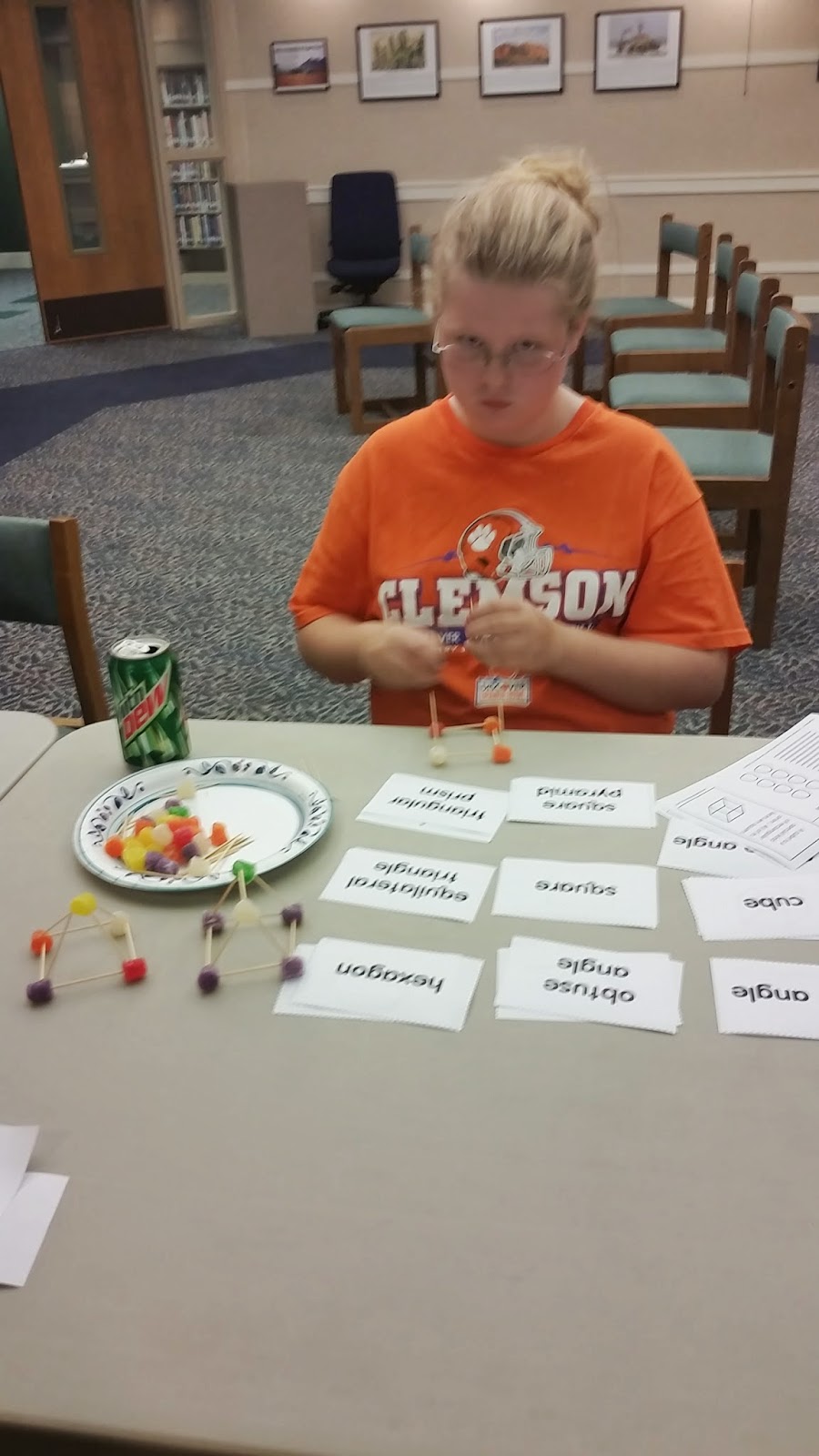
Gumdrop Geometry was the theme today.  Ms. Jean, the librarian, had made packets for the children to match the term to the shape and a packet to help in assembling the different shapes.


Egee and another older homeschooler were able to participate today because there was not many children there.  They had a good time reviewing the geometry shapes with the younger ones.


I was very proud of Little Man for reading and following the directions on his own.  I might have an engineer in the making!


 Little Man and Egee had a good time making the various shapes using toothpicks and gumdrops.


We also met new friends at the library class.  So, it was a great day all around.  We can't wait to go back next month!

Sunday, August 31, 2014

Latta Plantation: Revolutionary War Reenactment

We ventured back to Latta Plantation for their Revolutionary War Reenactment.  We have enjoyed other festivals and reenactments at Latta and wanted to see this one.

It was not as densely packed as the WWII or Celtic events.  However, it was nicely represented with both British and Patriot reenactors and some Hessian soldiers.  All the reenactors are very well versed in the time period they represent. 

We strolled through a booth selling herbs and tinctures that would have been used in the 18th century.  Egee just had to have a Jacob's Ladder toy.  Little Man wanted a wooden toy tomahawk. 


We listened to a British soldier describe life in the British army.  The differences between a ranking officer versus the common soldier.  The small tent that housed five soldiers compared to the large tents with real furniture in the officer's tent. 

We learned that General Cornwallis ordered the burning of the 'train' to chase General Greene through North Carolina.  The officers did not appreciate the burning of their furniture, tents, wagons, etc. 


We discovered the difference between a light infantry man and heavy infantry man.  No, size was not it.  We found out that the musket could be loaded five to eight times a minute compared to the American Long Rifle loading time of one round every minute and a half to two minutes.  So, the British had an upper hand at fire power. 


The cannons were vital in the war and we learned about the different sizes of cannon balls.  We learned how they were lobbed at the opposing forces and then the cannons switched to buck and ball loads as the armies advanced to closer range.  Two hundred and fifty balls could be launched at the enemy in one of the buck and ball shots. 

Cannon balls weren't the only projectiles.  The mortar launched bombs that could be used to breach forts or encampments of men.  We learned how the bombs were lit in the mortar and how each fuse and packing of the bomb was slightly different. 


We watched a blacksmith at work.  (Even though his forge was not of the period.  He has to use a portable one for the event.)  This always fascinates Little Man. 

We looked at the craftsmanship of a leather worker.  He showed us a suede bowl and bucket and told us how they worked.  He also demonstrated a gun tool that many soldiers would have used.  Then he allowed the children to hold his long rifle.  The children were surprised at how heavy it was.


We looked at the farm animals and petted them.  Of course, I heard chimes of I wish we had.... 


Finally, we witnessed the battle of the day.  Muskets and rifles fired and the Battle of Charlotte was taken over by the British troops. 


We had a great time even though the weather was hot and humid.  Can't wait for the next Latta event!

Thursday, August 28, 2014

Trying to Change the Education System is Like Trying to Reason with a Toddler

I posted the other day about how homeschoolers are getting the blame for not supporting the 'common good'.  Today, I ran across an article that is about trying to change the educational system for the greater good.  Now this isn't a parent group, or homeschoolers trying to change the educational system for them.  No...this is the SC Superintendent of Education trying to 'reason' with educrates that the system needs to change.


Dr. Mick Zais is not a typical educrate.  His experience in life is not from the public school classroom to public school administration to the public school distric office to public school superintendent to state superintendent.  He hasn't been brainwashed into the whole model of college is the only way to be successful. 

He has spoken out recently about the injustice that our educational system has on our young people.  He understands what the majority of homeschool parents have known.  College is not the answer for all kids.  He realizes that a student has a pretty good idea of what they want to do in life before they graduate and their educational experience needs to reflect this.

Now, to change the educational system to meet the true need of the student and society is a major undertaking.  It goes against everything the College of Education has preached and prepared every teacher to do.  It means that the teacher is not the center of the classroom and must be a true facilitator to help a student find resources to support their needs at any given time. (I know that the College of Education tells its teacher candidates that they are to be facilitators.  However, let us come to the reality that this cannot truly be done with the system that is in place now.  Self directed learning when high stakes testing is on the line.  Teachers' jobs dependent upon test scores cannot or will not allow a relinquish of control to the student.  The mighty test must be taught to at all costs.) 

However, if a true facilitator role is taken and the high stakes tests removed, schools can be changed.  Student needs can be met!  It means that higher mathematics and science classes may not filled with students.  It means that British Literature classes may have a handful of students and art classes are overflowing.  New classes may need to be added.  Business math will draw more students than Algebra II.  Entrepreneurship classes could replace sociology class.  The sky is the limit!  Courses change yearly based on student interests.  By courses, I really mean student needs.  Let's not pigeon hole into courses.  Oh, the disorder it would create in the institution of education!

Could you imagine a high school that is tailored purely to the student?  Where collaboration is truly celebrated and encouraged?  No high stake tests to prepare for at the end of the year.  Students teaching students is encouraged and the teacher is there to offer support not purely instruction.  Students that are artistic are allowed to create all day and attend workshops by local artisans to improve their craft.  Students that are focused in the sciences and want to pursue careers in these fields are prepped and given laboratory experience to expand their horizons.  They research what is required for the field they want and they seek out teachers to help them with their choices.  Oh, how high they could fly!  A school to be filled with living resources that can be accessed like Google.  True collaboration and mentorships with colleges and businesses would be real school to work!

The creation of such learning centers could lead to collaboration in all fields by students themselves.  Art students learning the science behind paint types and glazes; science and mathematic students learning the artistry within their field; literary students working with drama students to create new works of art; wood working students creating sets for drama students; welding students making structures dreamed of by art students; music students writing and performing their works for original plays and musicals; history students unraveling mysteries and reenacting events; computer students creating and sustaining networking for all the tech needs of the school; programming students creating new apps and programs to aid their fellow classmates in endeavors.  The list goes on and on and there are no limits. 

How could this type of school be managed?  How could we assure that all students learned?  Faith in our students is the number one thing that we must have.  Relinquishing control and authoritarian dictatorship of an institutionalized setting to an open and trusting mind bank atmosphere of trust.  I believe those 'weird' kids that get bullied would become embraced for their 'weirdness'.  Their 'weirdness' is only because they don't meld into the traditional school setting.  In the new educational model, these 'weird' students can showcase their talents in the arts or let their real inner geek out and collaborate with others that share the same interests.  A microcosm of the real world we live.  Wouldn't that be great? 

So what happens to those kids that aren't into the academics and arts?  You know the ditch diggers that so many like to refer to them.  Can these kids fit into this system?  Sure, if all the others know and understand the value of this type of work and that the worker is no less a person.  Aren't we all thrilled when the plumber shows up to fix a stopped toilet at our house?  Do we think less of him?  No.  We appreciate his skills, but when our child says, 'I think I want to be a plumber,' we dismiss it and point him in another direction.  Why?  Haven't you seen how much plumbers can make?  Sanitation workers, HVAC workers, construction workers, food prep workers, childcare workers, etc. all have a place in our society and should not be looked down upon. 

The children that are fashionistas and can put together great looking outfits.  Ones that can rival professional hairstylists or make-up artists are looked down upon if they are not academic for school.  These students can shine in the drama department and yes, they are really artist just working with a different medium.  What about the child that is quick witted and makes everyone laugh?  He doesn't enjoy math or science or really any academic pursuit.  He knows about the real world and looks upon it differently.  He can make fun of the seriousness, yet at the same time he is making everyone aware of what is happening in the world.  We as adults spend serious amounts of money going to comic venues. 

There is so much more than school in life.  Pure desire to learn is within every human.  Unfortunately for many, school is a prison that they are waiting to escape from and experience life.  By the time the finish line is in sight, many have lost any desire to learn and many dreams have been crushed.  Let us meet the needs of the children by providing resources to encourage their God given abilities.  Whether it be the baker, chef, teacher, scientist, doctor, lawyer, line cook, cosmetologist, nanny, writer, etc.  Let us let the child explore and find the right fit and nurture their desire. 

However, my reasons and ideas above would be dismissed by the educational system.  The educratic system could not measure the success of the students in the this model with the typical high stakes test created by Pearson or the like.  Because in education, if you can't measure academic success with a test, then learning must not be taking place.  So, let us just throw more money at the beast and never enact real change. (Thank goodness I home school my children!)

Tuesday, August 26, 2014

Teen Social

Oh, my!  The years have flown by and now my little girl is almost a teenager.  Ugh!  How did the years go by that fast? 

Egee attended her first teen social for fellow homeschoolers.  It was an informal get together with other preteen to teenage homeschoolers and she was excited.  An opportunity to make new friends and hangout without little ones running about.


The event was Christian based and fully chaperoned.  Most parents dropped their children off and went on their own date night.  We were no exception.  She was in a safe environment with plenty of kids around her age to interact.  No need for Mom and Dad to stand around and gawk. 

Two hours passed quickly and when I arrived to pick her up, she was wrapped up in fun.  Hopefully, new friendships blossom and she continues to meet more homeschool kids her age.  She can't wait until the next one!

Monday, August 25, 2014

Home School Jamboree

We attended the first annual Home School Jamboree last week.  There was a great turn out and plenty of things for the children to see and do.  It is wonderful to live in an area that has such a supportive home school community.


The children enjoyed learning about the local police department's motorcycle patrol.


The fire department had one of their fire trucks to explore.


EMS had an ambulance for the children to look inside.


There were games, face painting, art demonstrations, hula hoops, and a mini soccer field.


There were several groups handing out information on clubs and classes for home schooled children.  It was nice to see how many activities are out there that I didn't know about.

Overall, the jamboree allowed us to interact with others that share our interests and have fun!


Saturday, August 23, 2014

So, Educating My Child at Home Does Harm to the Common Good?

A friend posted an article on her Facebook page that I found intriguing.  The article "NC homeschools and abandoning the common good" left me in disbelief.  Ms. Maxwell (author) points out the growing trend of leaving public and even private schooling and turning to homeschooling.  North Carolina's homeschooling numbers are growing by leaps and bounds and she feels that parents would rather care for their own child's education rather than try to change the system.  Thus, they are abandoning the common good.

Now, I have been in the educational system.  I taught approximately 150 students a year and stood in a classroom teaching a variety of children from different socioeconomic backgrounds.  The first few years I taught, I did not have mandated standards to be a slave toward.  I could gauge an interest level in my students and adapt as needed. My classes were rigorous, but were tailored to the need of the student.  I had flexibility to slow down on a topic, go back to previous topic, or change topics as I saw fit.  If one class needed extra practice on genetics problems, we could spend extra time.  If another class caught on and mastered the skill before the other class, we could move on to more complexities for that class.

Three years into teaching, the state finally adopted science standards and decided to create an end of year exam for the courses I taught.  My freedom of tailoring to my students needs started to diminish.  Slowly, I was having to teach solely to the standards and had no more flexibility to slow down and spend extra time on a topic for mastery.  Those that got it, got it.  Those that didn't, had to move on.  I was available for after school tutoring, but few would come.

As the years passed, I noticed that there was an undertone to kids that were struggling.  They were giving up and just going through the motions of being at school.  There wasn't time for them to master a topic and feel good about themselves.  They did just enough to try and make the bare minimum passing rate on a test of for the year.

As a teacher, I tried to explain this to the instructional coach, the department chair, the guidance counselors.  I tried to get the students that needed the extra help to stay after school, but they had jobs or just didn't want to be at school any longer.  Other teachers and I would talk about how education needed reform, but how the system just doesn't want to do it.

I had my own children around this time period.  I told my husband that I didn't want to send them into the school system.  We knew that in our situation, our oldest child may have to attend a few years of schooling.  I knew I had to remain vigilant on her behalf.

She attended kindergarten through third grade.  The first year of school wasn't too bad.  She has always been one to obey and do what she is instructed to do by an adult.  She enjoyed learning and was well ahead of many of her classmates.  The first grade year was okay.  The teacher wasn't bad, but she wasn't great.  I had to reteach many misconceptions taught to her during that year.  Second grade started wonderful, but then the teacher left for maternity leave.  Stress began to kick in with all the testing that was required.  By the end, my innocent, love for learning, child was starting to disappear.  Third grade became worse.  The stakes were high for the teacher.  This was the year that the students took the state exam.  I was amazed at what I thought was being taught.  Then found out it was just being given to memorize and regurgitate back out.  I was in disgust.  My child was having to take AR tests weekly.  Reading became a chore and not fun.  MAP testing was done three times a year.  Unit tests were constantly being given on one topic or another.  Tests, Tests, Tests!  The educational system was out of control and as a teacher and parent, I could not change it.  That is, unless I took complete control and decided to homeschool.

That is exactly what I did.  I was tired of seeing what the system was doing in my own classroom and angry about what it was doing to my child.  Are we rich? No.  Homeschooling is a sacrifice.  Our material wants are placed on the back burner, while our children's needs are meet.  How does this harm the common good?

We are still tax payers.  Our tax money goes to education.  We don't receive a tax incentive or break for homeschooling.  The educational system does not have two extra children to make room for in the overcrowded classroom.  The money that would go to educate my children is now dispersed amongst others.  The teachers don't have to try and individualize my children's needs.  How does this harm the common good?

The author refers to Emily Matchar (author of "Homeward Bound) and quotes Matchar as saying, “Historian Janet Golden observes that we’ve abandoned the idea of communal good in favor of individual, family-focused solutions.” That means “there are fewer people … volunteering to improve the public schools.” She describes it as “opting out” of the social contract.

I don't know about you, but I never signed a social contract.  Fewer people are volunteering to improve public schools because most have caught on that public education does not want to be improved.  Common Core is a prime example!  If more American citizens would read, "The Deliberate Dumbing Down of America", they would be astonished of the true intent of the public educational system.  

There are many people with no children in public school trying to get rid of Common Core.  There are rallies and protest.  However, if you ask many public school parents about Common Core, they looked puzzled and haven't a clue what you are talking about.  Some may shrug and state they don't like Common Core and then follow up with a statement, but I have to send them to school anyway.  Do you?  You do have a choice, but it may come with a sacrifice.  Is your child's education and well being worth the sacrifice of that new car or expensive vacation?  You may have to scale back your wants and decide that your child is more important than the 4000 square foot house.  If you can live in a modest house on one income and put your child's education first, would you?  I know how we answered that!

Emily Matchar in her book "Homeward Bound" also states the following, "“Parents with high socioeconomic status – the ones with the greatest social and political clout – advocated for policy changes that ultimately benefited everybody,”  Now, according to Ms. Maxwell this was from the historic context of the Progressive era (1890-1920).  What I am seeing and have researched is that most high socioeconomic families do not send their children to public schools.  They elect to send their children to private schools or have them tutored at home.  They influence their own child's education by picking and choosing how the school or tutor they want.  How is this any different from what homeschooling parents do for their child's education?

The school reform that came in the 1890s and early 1920s called for mandatory attendance.  Basic education for all citizens.  Literacy programs so that all could read and write for their own welfare.  The Prussian education system was set in place and modified to fit the needs of the United States.  The needs of the industrialized workforce.  The sole purpose of mandatory public education is provide a industry with a labor force that can read and calculate to fulfill an entry level position. 

Through the course of 'educational advancement' we have dumbed down the k-12 system and now the colleges are seeing the effects.  Remedial classes in colleges are becoming the norm.  They are having to bring up to speed students that should never have been admitted through their doors.  The greed of the educational system is to convince every parent and child in America, he is nothing without a college diploma. 

Homeschooling families have caught on to this ploy from the education system.  (At least the majority of them.)  The homeschool families that bravely call themselves unschoolers or eclectic homeschoolers are teaching their children to hack their educations.  College is not the means to everything.  Unless your child's passion requires them to obtain a college degree, hack it!  Why does this harm the common good?

In her closing, Ms. Maxwell states, "Such a solipsistic view is detrimental to society as a whole as well as to our individual families. What good is one family without another? One neighborhood without another? One town without another? We need each other. It takes all of us to build a better society."

Trust me, contrary to popular belief the home school community is large and vast.  We do not hide in our homes and keep our children locked away from society.  We have friends that are Christians, Catholics, Atheist, Jewish, etc.  We have friends that are single parents, homosexual, multi-generational, etc.  We volunteer within our communities and come to the aid of others in need within our community.  Our children experience all this without being promised a class party if they do xyz for the community.  They do it because we are teaching them what real adults do in a community and the real reward is found deep inside yourself, not the class party. 

Homeschooling does not harm the common good.  It allows for self thinking and discovery.  It allows children to fit into the real world they are not realistically preparing for in institutionalized education.  This generation of homeschooled children and the next and the next will make a change in the educational system of the United States.  It is because the only way the public educational system is going to really change is to take away its base and that is its children.  We cannot take away the money from taxes, but we can take away our children and send the message that until things change our best option is to school elsewhere.

Read more here: http://www.newsobserver.com/2014/08/21/4086856_nc-homeschools-and-abandoning.html?sp=/99/108/&rh=1#storylink=cpy

Read more here: http://www.newsobserver.com/2014/08/21/4086856_nc-homeschools-and-abandoning.html?sp=/99/108/&rh=1#storylink=cpy

Read more here: http://www.newsobserver.com/2014/08/21/4086856_nc-homeschools-and-abandoning.html?sp=/99/108/&rh=1#storylink=cpy